
2♦ — What Makes the Two of Diamonds Happy… and What Destroys Their Peace
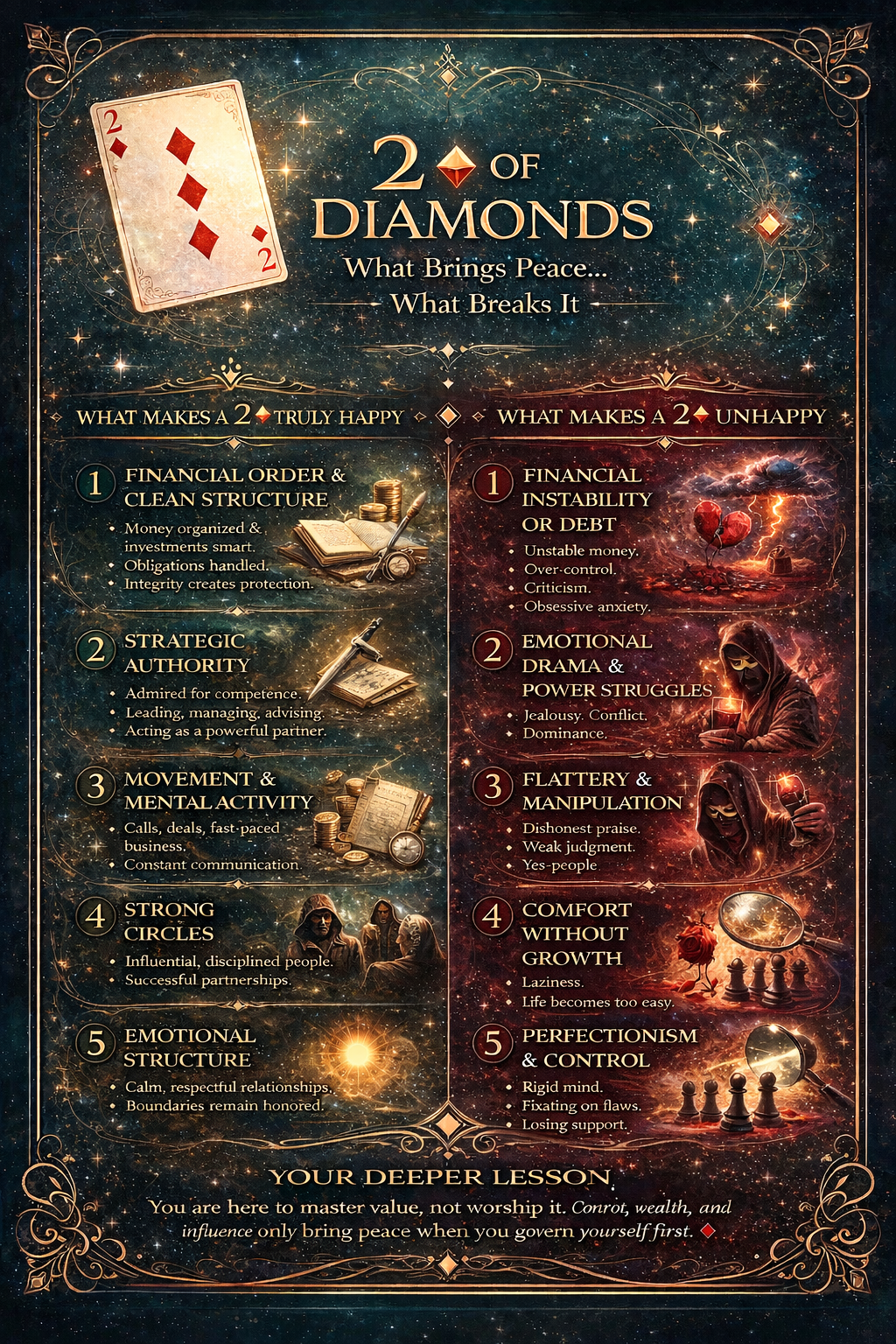
The Two of Diamonds is the card of wealth, partnership, power, and balance.
You are not here simply to earn money. You are here to master it — to work with value, agreements, and influence without becoming controlled by them.
Your life moves between security and risk. Control and surrender. Love and independence.
Your happiness depends on balance.
Your unhappiness comes from extremes.
What Makes a 2♦ Truly Happy
1. Financial Order and Clean Structure
You feel stable when your material world is structured:
• Money is organized
• Investments are strategic
• Obligations are handled
• No debt lingers in the background
The 6♦ Mars influence operates quickly in your life. When you act with financial honesty and responsibility, protection follows. When you neglect obligations, consequences appear just as fast.
Integrity equals protection.
You are happiest when your finances feel clean, controlled, and intentional.
2. Strategic Authority
Your 8♠ Neptune influence seeks control of systems, not chaos. You thrive when:
• You lead
• You manage
• You advise
• Your competence is recognized
You are not built for permanent subordination. You need responsibility and structured power. Authority stabilizes you.
Partnership also activates your potential. You are the resourceful merchant — wealth multiplies through collaboration, not isolation.
3. Movement, Deals, and Mental Activity
You are wired for motion:
• Calls
• Meetings
• Negotiations
• Agreements
• Planning
Business flow energizes you. Silence in activity feels unnatural. Boredom exhausts you more than hard work ever could.
Your mind functions best in exchange — strategy, communication, and cooperation.
4. Strong Circles and Influential Environments
You rise when surrounded by capable, disciplined individuals.
Your environment shapes your success.
Strong networks expand you.
Weak or manipulative circles destabilize you.
Prestige and association matter to you — whether you admit it or not.
5. Emotional Structure and Peace
Though outwardly strong, emotional chaos drains you.
You function best in relationships where:
• Boundaries are clear
• Drama is minimal
• Respect is mutual
• Admiration replaces competition
You need emotional stability more than intensity.
What Makes a 2♦ Unhappy
1. Financial Instability or Debt
Nothing triggers you faster than financial uncertainty.
When money feels unstable, you may:
• Over-control
• Become rigid
• Judge others
• Obsess over minor losses
Your fear is not poverty — it is loss of control.
Often, anxiety is habitual rather than realistic. Learning to distinguish real risk from imagined threat protects your peace.
2. Emotional Drama and Power Struggles
Conflict may feel stimulating at first — but it exhausts you over time.
Jealousy, dominance, and anger erode your stability.
When control enters love, peace leaves.
3. Flattery and Manipulation
Your greatest vulnerability is praise with hidden agenda.
You enjoy recognition. But excessive flattery clouds judgment.
Yes-people weaken your clarity.
Discernment protects you more than admiration does.
4. Comfort Without Growth
When life becomes too easy, you may:
• Lose ambition
• Avoid discipline
• Drift into laziness
• Seek stimulation elsewhere
You need creative challenge. Comfort without purpose breeds restlessness.
5. Perfectionism and Control
You see flaws quickly. When insecure, you:
• Criticize
• Label
• Attempt to fix others
• Become mentally rigid
This isolates you. Control replaces wisdom. Influence becomes intimidation.
The Core Pattern
Your life carries a Saturn–Mars–Neptune tension:
• You seek control.
• You fear loss.
• You dream ambitiously.
• You calculate strategically.
Happiness comes from disciplined ambition combined with emotional maturity.
Unhappiness comes when:
• Control becomes domination.
• Intelligence becomes manipulation.
• Security becomes paranoia.
When balanced, you are:
Strategic. Influential. Financially capable. Charismatic. Respected.
When imbalanced, you become:
Controlling. Restless. Jealous. Emotionally reactive. Internally anxious.
Your Deeper Lesson
You are here to master value — not worship it.
Wealth fulfills you only when aligned with integrity.
Power stabilizes you only when paired with restraint.
Partnership strengthens you only when grounded in mutual respect.
Money is a tool.
Authority is a responsibility.
Influence is a test.
Peace comes when you govern yourself
—not when you manage everyone else.
That is the true wealth of the Two of Diamonds. ♦
If we compare 9♦, 3♦, and 2♦ strictly from a psychological–destiny perspective (not luck, not money, but sustainable inner happiness), the difference comes down to complexity of lessons and emotional volatility.
Here is the clear breakdown.
9♦ — The Giver Who Must Let Go
Core lesson: Detachment from material control
Emotional theme: Generosity vs ego
Main struggle: Loss, endings, surrender
The 9♦ is a card of completion. Happiness comes only when this person learns to release expectations, control, and attachment to outcomes. When aligned spiritually, 9♦ can be deeply fulfilled, generous, peaceful, and abundant.
But when imbalanced:
They fear loss. They cling to money or status. They swing between philanthropy and self-protection. Disappointments hit hard.
Happiness level potential: High — but only after maturity.
Early life often feels unstable because 9♦ must learn surrender.
→ 9♦ happiness depends on spiritual growth.
3♦ — The Restless Seeker
Core lesson: Mental discipline & inner peace
Emotional theme: Truth vs overthinking
Main struggle: Anxiety, doubt, relationship instability
The 3♦ is mentally intense. Their happiness depends on calmness and spiritual grounding. If focused, they can reach very high wisdom and serenity. If scattered, they become restless, secretive, overly analytical, or emotionally disappointed.
Common imbalance:
Overthinking relationships. Attracting unreliable partners. Fear of betrayal. Oscillating between spirituality and strategy.
Happiness level potential: Moderate — unstable unless spiritually disciplined.
3♦ has enlightenment potential, but peace is fragile without focus.
→ 3♦ happiness depends on mental mastery.
2♦ — The Strategic Builder
Core lesson: Balance between money and emotion
Emotional theme: Control vs trust
Main struggle: Anxiety around security
The 2♦ is the most structurally stable of the three. This card thrives in partnerships, organization, money management, and authority. When finances and relationships are balanced, 2♦ feels safe and satisfied.
Their imbalance shows as:
Control issues. Perfectionism. Emotional drama. Fear of debt or instability.
But structurally, 2♦ has:
Strong protection in Saturn. Long-term financial stability. High leadership capacity. Practical mind.
Happiness level potential: Highest among the three — if ego and control are regulated.
2♦ struggles are psychological, not existential like 9♦, and not as mentally volatile as 3♦.
→ 2♦ happiness depends on emotional maturity.
Final Comparison

Who Has the Best Chance to Be Happy?
2♦ — statistically and psychologically.
Because:
Their lessons are about balance, not loss. Their protection is strong when disciplined. Their instability is self-created, not karmic-heavy like 9♦. Their mind is practical, not fragmented like 3♦.
However —
The happiest of all three long-term can become the 9♦, once they truly master detachment. But that usually happens later in life.
If you measure early-to-midlife happiness → 2♦ wins.
If you measure spiritual fulfillment at maturity → 9♦ can surpass.
3♦ has the most fragile happiness unless they cultivate inner discipline.
About The Author

elizabeth