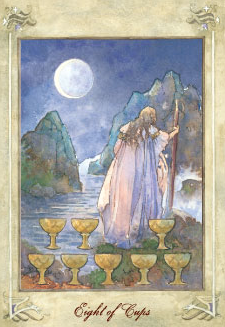
You are strong enough to gain wisdom from a challenging experience. As Etteilla suggests, this card serves as a warning against misplaced trust. It invites you to look inward and understand what drives occasional feelings of pessimism or emotional heaviness.
With the Eight of Cups, attention turns to the inner self—recognizing the part of you that may still be holding onto old wounds. For the most part, you are moving forward with your life. Yet there may be a part of you that resists healing, quietly clinging to past hurt.
Are there unresolved losses of faith or trust you continue to carry? If so, this is an important moment to examine your current motivations and release what no longer serves your growth.
The Poisoned Waters of Love: Two Lotuses in Still Water
Gerd Ziegler writes that when emotional waters are no longer renewed, they begin to stagnate. What once flowed freely grows heavy. A toxic fog rises, eclipsing clarity and dimming light. Two lotus petals still release their energy—two loving hearts, still open—but even they are slowly swallowed by spoiled, unmoving water.
This image speaks to love under pressure. A deep connection may exist, yet circumstances work against it. Destiny seems to test the bond, draining it instead of nourishing it. When renewal no longer comes, chemistry fades—not suddenly, but gradually. And when one heart begins to overgive or emotionally manipulate in an effort to save what’s slipping away, the imbalance turns the relationship toxic.
You may already feel this. You have given enough of your strength to someone who cannot give back. You keep pouring energy in, hoping love will revive itself, but the space feels bottomless. The more you try to restore what’s stuck, the more exhausted and empty you become.
This is not failure. It is a signal.
Turn back toward yourself. Protect what remains.
In relationships or marriage, the Eight of Cups often points to incomplete fulfillment—mixed with compassion. There may still be care, loyalty, even tenderness, yet something essential is missing. Unspoken worries linger. Quiet dissatisfaction hums beneath the surface. The card asks for honesty: to appreciate what is present, while also acknowledging what is no longer alive.
Do not deny the sadness or pessimism that arises. Repressing truth only pushes it deeper, where it emerges elsewhere in the psyche. Instead, look directly at the fear, the hesitation, the grief. Accept them without judgment.
Sometimes letting go is the only way to interrupt the poison. When giving more only creates more toxicity, release becomes an act of love—not just for yourself, but for the situation itself. And in that release, something unexpected may happen: balance may return, emotions may settle, and clarity may quietly take its rightful place.
Ruler of Rejected prosperity, Lost Success
Denial and Self-denial
Fate Obedience
Cessation of efforts
Lethargy, laziness, negligence
Fading light, Eclipse, Falling Atlantis
Timing and Correspondence
Associated with the first decade of Pisces (ap yeahproximately February 19–29).
Astrological Equivalent This phase is influenced by Virgo and Scorpio, combined with the first decan of Pisces. Saturn in Pisces highlights themes of limitation, surrender, and emotional gravity. The Saturn–Moon symbolism carries a mood of melancholy, separation, and quiet farewell.
Esoteric Meaning
At its core, this archetype speaks to search—a withdrawal that is not an ending, but an inward turning. Meaning is sought beyond external success, ambition, or visible achievement.
Themes of denial and self-denial often arise here, along with obedience to fate and a quiet sense of resignation. This energy reflects a cessation of effort—whether caused by exhaustion, disillusionment, or the realization that continued striving no longer brings results.
States such as lethargy, inertia, emotional withdrawal, or neglect may surface. The imagery is one of fading light: an eclipse, gradual decline, or the mythic fall of Atlantis—what once flourished slipping beneath the surface.
When the Eight of Cups appears in a spread, interpretation can be challenging. Its message is subtle and layered, requiring careful attention to context, emotional tone, and the motivations behind withdrawal.
Eight of Cups — Upright
The cups are still full, but they no longer speak.
What once shimmered now echoes. What once promised asks nothing more of you.
So you turn— not in anger, not in defeat, but in knowing.
Behind you: a life that worked, almost.
Ahead: no map, only the quiet pull of something truer.
You walk because staying would be the real loss.
General Meaning
A person is looking for a spiritual path because he changed his life goals and priorities.
The most traditional meaning of the Eight of Cups is “oblivion of previous plans.” The fact that until recently, a person cared for his dreams and was inspired by “visions ” of the Seven of Cups, which precedes Eight of Cups, now loses its attractiveness; the interest wanes, for some reason, ceases to exist, knowing that this is not “a life” he had a dream.
The magical fairy tales of the Seven of Cups have run dry. A person realizes they’ve paid an emotional price—giving far more than they ever received. Over time, that imbalance becomes impossible to ignore.
Eventually, a quiet moment arrives when the person turns away from those dreams. It is a farewell—to an old sorrow, to outdated ideas, and to habits that once felt familiar but no longer serve. This turning away is not bitterness, but release.
A person walks away, leaving behind past triumphs and dreams. Like the figure in the Eight of Cups, they move forward with quiet resolve—leaning on a staff, humbly and deliberately stepping away from the rocky shore.
Behind them stand the eight cups, frozen in place, symbols of past success that no longer hold life or movement. What once defined achievement is now left behind, not in defeat, but in recognition that the journey must continue elsewhere.
A person comes to recognize the limitations of their former life. The Eight of Cups delivers a clear message: the moment has arrived. It is no coincidence that the card often depicts an eclipse, stressing the importance of a time factor.
In negative surroundings, the Eight of Swords may indeed indicate a sure eclipse of the “darkest hour” of life, when a situation is hopeless, forces are exhausted, a lost battle, a collapse of ego). In a more positive sense, Eight of Cups means that a person unleashed the past, throwing the usual bog and going into voluntary exile – to evolve.
A period of temporary solitude may be necessary to reconnect with what truly gives life meaning. This is a time for focus, reflection, and meditation—a pause that allows clarity to emerge.
Crowley emphasizes that the person is surrounded by harmful company—an environment that subtly poisons and diminishes them. Remaining in such negativity leads to stagnation and gradual self-destruction. When the surroundings are inert and emotionally stagnant, there is no space for growth, and creative potential remains unrealized. Leaving this environment behind becomes not just necessary, but essential for renewal and development.
By the way, a meaning of Eight of Cups also includes a possibility that a person makes mountains out of a molehill – it is not so scary, is not so important; — a person will realize it as soon as he starts to take first steps and see everything from a close range.
On a Deeper Level
The Masonic symbolism of Eight of Cups represents a candidate ready for initiation into the mysteries, surrounded by eight masters. He or she says “goodbye” to worldly goods and worldly pleasures. In fact, the eight of Cups is a card of vows. A person knowingly and voluntarily departs from temptations of everyday life for the sake of a high and narrow path to dive into an inner world. The Eight of Cups has a lot in common with the Hermit. An image of a stranger in a trench coat, leaving his way to his ultimate goal to find enlightenment in depths of loneliness. The difference is that the Hermit is centered and calm.
A person is taking a journey inside himself to search for spiritual truth. His quest is a journey of knighthood for his soul (which symbolizes the Holy Grail). The mountains signify his search for spiritual heights, and his pilgrim’s staff is a symbol of willpower and wisdom.
This card has accentuated relation to astrology.
Firstly, it depicts a time of an eclipse. A meeting of a Moon and a Sun is a fatal moment.
Possibly a person is peculiar to a subjective perception of events and fascination with surreal and romantic anxiety about things that do not exist in objective reality, but they lie down at the bottom of our subconscious.
The Light and Shadow
Advice: Do not make any drastic changes. You need to take a vacation, meet new people and renew. You also can get a temporary solitude to meditate and see your life through a magnifying glass.
Warning: Do not run away from a situation. It may seem logical and morally justified to move, — a person can think he is doing something heroic, — but in fact, this is just a path of least resistance. “Not renounce loving.” This is time to abandon the familiar (or to quit his promises and intentions) and go aimlessly somewhere, anywhere, — where the grass is green er. No good deed goes unpunished, and the best the enemy of the good.
Personal Relations
A person begins to see their partner without fairy-tale illusions, realizing that perfect princes and princesses do not exist. This shift invites a more realistic and grounded understanding of love. From here, the relationship can move to a deeper, more conscious level—one shaped by honesty, acceptance, and the willingness to take meaningful steps toward genuine happiness and openness.
In some cases, the card signals marriage for someone who never intended it, yet now feels ready to change their life. Marriage here may initially feel like a monastery—when a former playboy willingly “takes the veil.” Random relationships are left behind in favor of commitment, restraint, and integrity.
This marks the beginning of a new chapter: accepting responsibility, forming lasting bonds, and gradually adapting to a more grounded way of life.
This reflects a sense of powerlessness in the current situation—unmet expectations, disappointment, emotional burnout, and stagnation. Growing pressures make it clear that change is needed, but the energy or inner drive to act simply isn’t there yet.
The result is emotional shutdown. The heart feels numb, motivation fades, and feelings may be consciously or unconsciously blocked as a way to cope. It’s not a lack of awareness—just a moment where the system is depleted and needs time to reset.
Reversed Eight of Cups: Clarity After a Misstep
The reversed Eight of Cups indicates that a mistake has already been made. The lesson now is not denial, but reassessment. This card encourages a change in attitude—learning to appreciate what is already present instead of rejecting it or walking away too quickly.
In relationships, the most positive expression of this energy shows two people willing to work through difficulties with patience and tact. Like diamonds shaped through pressure, two strong personalities learn to adjust and grow together rather than break apart.
Here, emotions are conscious and self-aware—guided by reason as much as by feeling. This balance allows love and practical life to coexist without damaging each other. Relationships do not interfere with professional goals, and work does not undermine emotional connection.
At the same time, the Eight of Cups can signal a temporary cooling in love. The card may advise postponing emotional decisions, placing relationships “on hold,” and focusing instead on planning, inner work, meditation, or quiet reflection. This pause is not abandonment—it is a strategic withdrawal meant to restore clarity before moving forward.
Reversed Eight of Cups – False Exit and Second Chances
There is a strong desire to attract attention and provoke interest—often through creating an artificial personal story or cultivating an air of mystery. At the same time, the person is unable or unwilling to leave a situation, yet pretends to be on the verge of departure. It is a performance rather than a real exit.
Warning: others are more perceptive than you think. These tactics are likely to be seen through.
Despite this, the card carries a note of future luck. Under the influence of Scorpio, an unexpected gift or opportunity may arrive—something long desired and previously thought unattainable. This moment offers a second chance, but only if approached with honesty rather than illusion.
Eight of Cups — Reversed
You say you’re leaving, but your feet haven’t moved.
The goodbye is rehearsed. The door remains open. You linger in the frame hoping to be called back.
You circle what you know and call it searching. You build meaning from delay and name it patience.
The cups wait. They always do.
But this card asks plainly: Is this hesitation wisdom— or fear disguised as depth?
The moment offers itself again. Whether you take it is the only question left.
Personal Feelings – The Spiritual Hangover
In Crowley’s interpretation, the overly exhausted Eight of Cups follows the dissolving ecstasy of the Seven of Cups. It represents a kind of emotional and spiritual “hangover” after a period of excess—too much pleasure, indulgence, and unchecked desire.
Feelings are spent. Emotional resources are depleted. As a result, the person begins searching for a way out—not through more stimulation, but through introspection, soul-searching, or spiritual development.
Here, the choice is intentional. The person consciously turns toward self-restraint and renunciation, not as punishment, but as a way to rebuild inner strength. By limiting excess, willpower is restored, and the deeper force of inner purpose can finally be directed with clarity and discipline.
The Cost of Hesitation
One of the oldest interpretations of the Eight of Cups is the avoidance of temptation. A person chooses to walk away from what could be gained—preferring to give up rather than risk reaching for an opportunity. Symbolically, this is the moment when someone turns away from a full cup of love and enters solitude instead.
Because of this, a traditional meaning of the Eight of Cups is missed opportunity. Everything is visible and understood, yet consciously declined.
Conventional interpretations paired with the Eight of Swords suggest that a person can obtain what they hope for—including love—if fear, caution, or shyness do not completely hold them back. When the Eight of Cups appears in a spread, it often shows that circumstances are generally aligned and moving as expected, but inner insecurity prevents action.
The risk here is hesitation. Being too careful or emotionally withdrawn may cause the person to lose what they truly desire. This card ultimately carries a warning: fortune favors those who step forward. To claim what the heart wants, action—not retreat—is required.
Detached Harmony
In its upright position, the Eight of Cups can reflect practicality, social awareness, and the ability to maintain harmony with others while keeping healthy emotional distance. In traditional interpretations, this card also pointed to a tendency to live fully in the present—without dwelling on the past or worrying about the future.
At times, the Eight of Cups may describe people who simply go with the flow, drifting rather than choosing a clear direction. There can be a sense of aimless wandering—a search for something undefined, without knowing exactly what is being sought.
Eight of Cups with Other Cards
With the High Priestess — solitude, withdrawal for inner reflection
With the Hermit — a search for deeper meaning; temporary isolation and conscious solitude
With Strength (Power) — inner resistance, the courage to make a decisive choice, breaking habits, and attempting to overcome dependency
With Death — departure, endings, and irreversible transformation
With the Devil — decline through destructive habits or harmful belief systems (including cult-like influences)
With the Sun — the Sun softens and weakens the negative influence of the Eight of Cups, bringing clarity and relief
With the Three of Wands — travel, expansion, and opening to new horizons
With the Eight of Wands — completion of a life phase; the cards reinforce each other, plans come to fruition, and space opens for new ideas
With the Nine of Wands — confidence, endurance, and resilience
With the Six of Swords — a positive spiritual journey, healing through transition
With the Ten of Swords — burning bridges, irreversible withdrawal, extreme endings; in rare cases, this may indicate self-destructive thoughts or behavior
Reversed Eight of Cups with the Three of Cups – debtor is to pay the debt.