
Three of Swords – Lord of Sorrow and Negative Thinking
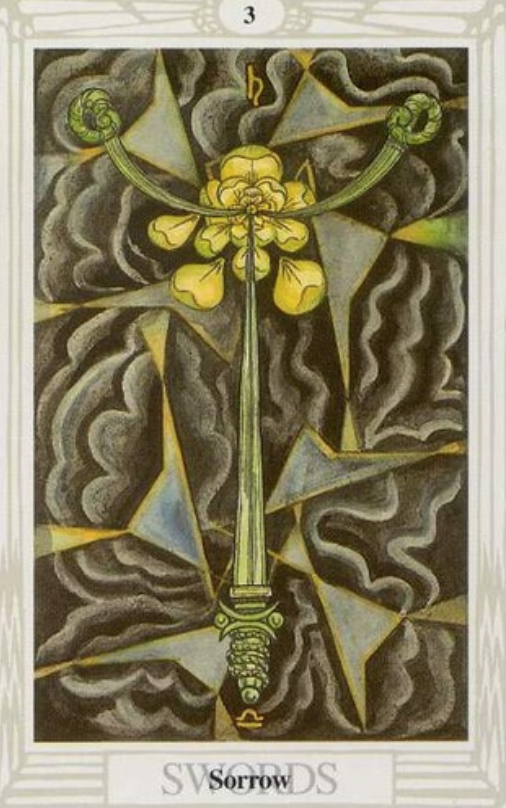
The Three of Swords is the Universal archetype of Sorrow and Negative thinking. This is a sorrow that lives in the mind, turning over again and again. It is the habit of looking back, replaying memories, and holding on to the moments that broke the heart. The Three swords show how deeply this pain cuts — to the very core of our nature.
Pierced by sharpened steel,
dreams dissolve in falling rain—
a heart stands alone,
yet from the wound light will rise,
truth blooms where sorrow has cut. – My Poetry – Liz Violette
 Symbolism and Associations of the Three of Swords
Grief and Sadness: At its core, this card is the “Lord of Sorrow,” the universal symbol of heartbreak and loss.
Astrological Timing: It aligns with the second decan of Libra, from 3 to 12 October, a period often marked by lessons in balance and painful truths.
Planetary Links: The card echoes the energy of Saturn in Libra, and carries resonances of Aquarius and the seventh house — themes of justice, partnership, and karmic lessons in relationships.
Mars and Moon: Together, they represent hurt feelings, raw emotion, and the clash between passion and vulnerability.
Mercury’s Shadow: When Mercury is involved, it shows a decision made against the heart’s true desire — the mind choosing a path that the soul resists.
Occult Meaning: On a deeper level, this card symbolises the gap — the wound, the break, the moment when connection is lost and the soul feels divided.
The Three of Swords reminds us that the mind, with all its logic and stories, eventually has to surrender to something higher. True sorrow isn’t just pain; it can also open a doorway to awakening. In fact, this card points to the same profound grief that first set the Buddha on his path to enlightenment. Lon Milo DuQuette, in his work on Crowley’s Thoth Tarot, even calls it a “wondrous trance of sorrow.” Seen this way, heartbreak becomes more than suffering — it becomes a teacher. To draw this card is to be reminded that sorrow, though heavy, can transform into wisdom.
General Meaning in A Spread

The Three of Swords often points to incompatibility, sharp words, and misunderstandings that cut deeper than they should. It’s not a cheerful card — it usually signals a tense or uncomfortable period. This is the energy of quarrels, anxiety, anger, and clashes of interest. In many ways, it’s a test of your emotional resilience — how well you handle hurt and disappointment. The card also brings the heavy realisation that life lessons aren’t always gentle. If the Cups are the colours of the heart, then the Swords are the colours of the mind — cold, sharp, and sometimes painful to face.
With the Three of Swords, what you feel gets pushed to the background. The fog of emotional idealisation lifts, and you’re forced to see things as they really are. This is a card of the head — logic, clarity, and hard truth — but it’s shown through the image of a bleeding heart. It speaks of those moments when your mind and your heart are pulling in different directions, and no matter what you choose, the decision hurts just the same.
The Three of Swords often shows a moment when a choice is made against the heart. You may have to give up something — or someone — very dear to you. From the outside, it’s hard to tell whether this is cowardice or courage, but only you can know the truth. In this moment, your mind takes control and suppresses the heart, pushing you to break free from dependency. The step is painful, but it is also necessary — a sharp cut that, in time, can open the way to healing and freedom.
In old interpretations, the Three of Swords was often seen as a sign of a painful farewell. You may have to walk away, even though the leaving tears at your heart. It is you who suffers most from the decision, because it goes against what you deeply wish to hold on to.
Personal Feelings

The Three of Swords can describe two paths. In the first, you are the one going through suffering — facing sadness, heartbreak, and painful emotional conflict. In the second, you may be the one causing the pain, sacrificing not only your own heart but also wounding another. In these moments, you may act harshly without realising the depth of hurt you inflict. You might not even understand what you are doing, only that you are not happy with the way you behave. Critical, rational, and dismissive of unrequited love, you may feel as if your cup has been drained, dried, and cracked — unable to hold tenderness or joy. In this state, you can destroy what is most precious to your heart, and at the same time break the hearts of others.
This card also shows deep frustration and a clash with reality. You may feel out of place, unable to connect with those closest to you, withdrawn or unsociable, sensing a painful mismatch between yourself and the world around you. At times, it can feel like you are being forced in a direction you do not want to go.
Here the Three of Swords places you in crisis. You do not know what you truly want, because your mind and your heart are divided. Intellectually, you may know the steps to take, yet within your soul everything rebels. It is the painful crossroads of reason and feeling, where neither side brings easy peace.
Angry Victim Syndrome and the Three of Swords
The Three of Swords can mirror what psychology calls angry victim syndrome—a state where sorrow hardens into bitterness and the wound becomes a permanent identity. Instead of healing, you keep replaying the hurt in your mind, feeding anger and resentment. This trapped energy can push you into antisocial behaviour, mistrust, and a refusal to move on. Just like the heart pierced by swords, the pain defines everything. The warning here is clear: if you stay bound to victimhood, you remain imprisoned in sorrow. But if you face the wound with courage, the same blade that cuts can also bring clarity, slicing through illusion and opening a path to freedom.
On a Deeper Spiritual Level

Three of Swords is always symbolizes a desire for an unattainable ideals. You may find yourself rejecting reality as it is. In this tension, you might try to solve your problems with the wrong tools or in ways that only deepen the pain. The card challenges you to step onto a path of initiation — to turn inward, face the mystery of your own heart, and allow yourself to be transformed from within.
The second decan of Libra is about learning to set boundaries within your own mind. It asks you to recognise the patterns of logic that guide clear thinking, so that you can make fair and balanced judgments, even in difficult situations.
Saturn in this position is reflecting the ability to comply with established rules for the sake of greater harmony. You carry a strong drive for inner completeness and perfection, always seeking to feel whole. But your aspirations are shadowed by a fear of novelty and uncertainty. Under the energy of the Three of Swords, you may hold yourself back with excessive self-restraint, or look at the outside world with suspicion, as if other people could disturb your balance. The challenge here is to learn that harmony is not found by shutting life out, but by trusting yourself enough to remain open, even when change feels uncomfortable.
A Life Lesson of This Card

Sometimes we need to stop looking only inside ourselves for harmony and start seeing it in the world of relationships around us. Our thoughts are always moving and changing, just like life itself. In the picture of the Three of Swords, we see a heart pierced by three blades, with rain falling from dark clouds — a symbol of sadness. This image reminds us that life is full of contradictions, and that real understanding often comes with sorrow. Every law of life carries responsibility. To find peace, we need to humble our thoughts before the greater laws of the universe and accept truths that once felt too big for us to face.
Behind these words lies a simple truth: one of the most painful experiences we all face is the loss of our illusions. Sometimes it feels as if an entire world we once believed in has collapsed. At one time, we wanted our dreams to be real, and we held onto them tightly. Each of us has a heart, and each of us has hopes. We build them up in our minds, concentrating on them, meditating on what we think the world should be. But then comes the moment when we see that the world is vast, different, and far beyond the picture we imagined. The lesson of the Three of Swords is to stop being afraid, stop drowning in worry, and wake up to reality. When we make the effort to see the world as it truly is, we give ourselves the chance to be free — and even to be happy.
We can bring our brightest dreams into the world, but we should not expect the world to step aside for us. Instead, we need to make the effort to clear away the fog of our own illusions and see the world as it truly is. When we do, we begin to notice how reality itself starts to look more like the dreams we have carried within us.
Light and Shadow (tips and warning)
Tip: Drink the bitter cup of truth. Accept the sorrow that pierces your heart, and still choose to rejoice. This card calls you to practise modesty, patience, and humility. The dilemma of the heart cannot be solved until you find a way to restore lost balance — the lesson of Libra.
Warning: Do not force yourself to make a decision that goes against your heart. In such moments, whatever your mind decides will feel wrong or unstable. A broken heart cannot think clearly. Instead, turn to concentration and meditation until your mind becomes calm again. When peace returns, your heart will know the right path forward.
Professional Environment

In business, the Three of Swords strikes hard. Expect delays, poor prospects, and bitter disappointments. The Swords are the suit of the mind, and under this card the headache is certain. Failures, losses, and damage follow in its wake. It threatens bankruptcy, dismissal, broken partnerships, and contracts cut short. The Three of Swords is the blade of termination — a crushing force that shows no mercy.
The Three of Swords can bring disappointment in your career or profession. A role that once felt valuable and fulfilling may now reveal itself as hollow, no longer matching your hopes or expectations. What you once cherished turns into disillusionment.
The Three of Swords can show a growing aversion to your work. Duties feel heavy, every task a burden, and you drag yourself forward with resentment — cursing bosses, clients, and colleagues. This card speaks of loneliness and depression born from doing what your soul does not want to do. It is a wake-up call: open your eyes to what you truly need, and gather the strength to follow a new path.
Personal Relations

The meaning of the broken heart in the Three of Swords is clear to anyone who sees it — it speaks of love’s torment. Sometimes this card simply reflects your present state of mind: anxiety, fear, pain, or a sense of loss. These feelings may overwhelm you even when there is no clear reason for them. The Three of Swords shows the raw truth of sorrow, whether born of real events or of the storms within your own heart.
A traumatic encounter has left its mark. A relationship may now carry a shadow, or even a deep emotional wound. The Three of Swords reveals incompatibility — a situation where interests clash, and no matter how desperately you try to create harmony, it refuses to hold together.
The situation possibly started as a love triangle. A third person entered the relationship, and that intrusion caused the rupture. Now the partner knows the whole truth. There is an inability to choose between lovers, yet nobody is willing to walk away. The result is a broken heart, disappointment in love, and deep sorrow. The union remains fragile, balanced on cracks that could shatter at any moment.
According to the Three of Swords, you may feel a heartbreaking longing for what you have lost. What’s striking is that the suffering often falls on the one who chose to step into another relationship — even when everything before was nearly perfect, with only a few truths left unsaid. The card exposes the bitter irony of creating your own sorrow by chasing what seemed tempting but was never truly needed.
One of the oldest interpretations of the Three of Swords is monasticism — a withdrawal from love and partnership after heartbreak. The word comes from the life of monks, who live apart from the world, celibate and devoted to solitude. In readings, it means that after a deep emotional wound, you may feel unable — or unwilling — to enter into another relationship, choosing instead to close yourself off from intimacy.
In practice, the Three of Swords is often seen as the widower’s card, and its meaning can weigh more heavily on a man than on a woman. It can describe you when you feel as though you have lost the ability to love, living in a state of mourning even if your former partner is still by your side. You may be skilled, accomplished, and in the prime of your life, yet painfully aware of the judgment and lack of understanding from society. Inside, it feels as though there is no one left for you — no “then,” no “after” — only the silence of what has been lost.
Reversed Three of Swords

When reversed, the Three of Swords intensifies its shadows. Partnerships may break down into alienation, and you may resist pain so strongly that you refuse to acknowledge your sadness — which only freezes the heart and makes healing nearly impossible. In this state, you stop feeling anything at all, even pain itself.
In the reversed position, the Three of Swords sharpens its negative side. Your mind may sink into confusion — the Swords are still the suit of the head — bringing illusions, delusions, hallucinations, distractions, and even fatal errors. Miscalculations, losses, and disorder in your affairs can follow, all of which may lead to heartbreak. In this state, you are prone to mistakes and may even abuse relationships without realising it, blind to the harm you cause.
It is also possible that you compromise with yourself — ignoring what your heart truly wants and settling for less. This leaves you divided inside, never fully at peace with your choice
Sorrow is knowledge. They, who know the most,
must mourn the deepest over the fatal truth.
The Tree of Knowledge is not that of Life. ByronThis echoes the essence of the Three of Swords. With greater awareness comes sharper sorrow — the painful clarity that shatters illusions. Knowledge can cut as deeply as any sword, showing us truths we would rather not see. Yet in this sorrow lies wisdom, and in wisdom the possibility of freedom.
“The Three of Swords reflects a tendency in the mind to rework the old bones of the past, and particularly the parts of the past that contain sorrow or negativity. This is sorrow that could have resurfaced in the last three months… how we will handle subsequent triangles, whether they are friend-co-worker-friend, or friend-sibling-mate or friend-lover-mate.”
– Angeles Arrien (The Tarot Handbook)
Arrien’s words remind us that the Three of Swords is not only about heartbreak in love, but about the triangles of human relationships — those tense, painful situations where loyalties are split, and no side can win without someone feeling hurt. The card often points to the mind’s habit of replaying past wounds, returning again and again to what once brought sorrow. It challenges you to notice these patterns, to ask how you deal with conflict when more than two hearts are involved, and to choose clarity over confusion.
“This card is dark and heavy; it is, so to speak, the womb of Chaos. There is an intense lurking passion to create, but its children are monsters. This may mean the supreme transcendence of the natural order. Secrecy is here, and Perversion.”
– The Book of Thoth (Allister Crowley)
Crowley captures the raw and unsettling power of the Three of Swords. He describes it as the womb of Chaos — a place where creativity is born, but twisted by pain into something monstrous. In this sense, the card does not only represent heartbreak, but also the dangerous potential of sorrow when it festers in secrecy, distortion, or obsession. For you, it may signal the moment when hidden truths or suppressed desires rise to the surface, creating turmoil that forces transformation. The Three of Swords strips illusions bare, leaving only what is raw, chaotic, and real.
Etteilla – The Three of Sword

Keywords: distance, personality conflict, separation, worry in love, shadow dealings.
Direct – removal
Reversed – misleading
In the direct position, the Three of Swords promises tears and breakup. It reveals broken love, conflict, egoism, and selfishness. It can also show that you are tempted to act dishonestly, trying to justify your actions by any means. Something important may be lost at this time, or pushed away and delayed for an uncertain period.
In the reversed position, the Three of Swords warns of errors and distorted thinking. Your view of things may drift far from common sense, leading you into confusion. In business, confusion and disorder prevail — not always visible on the surface, but strong enough to drive you into reckless choices and foolish decisions. Conflicts are on the horizon, and the war is not far off, even if in the end it proves to be only a storm in a teacup leaving the stress and emotional damage.
The Three of Swords in Combination with Other Cards
In old tarot manuals, the Three of Swords was seen as a card that intensifies the meaning of any Major Arcana it stands beside. Here are some of the traditional pairings:
With the Fool — madness, or the risk of ending up in an asylum.
With the Emperor — the situation is not as tragic; union and stability are coming.
With the Hierophant — avoiding marriage.
With the Lovers — friends marriage is under attack, though it could be just a quarrel – look at positive cards.
With the Wheel of Fortune — luck gets tired quickly
With the Five of Cups — a heavy and sorrowful combination: deep grief, loss of love, heartbreak, widowhood.
With the Seven of Cups — resentment or insult.
With the Ten of Cups — joy, union, reconciliation; the Ten of Cups softens the pain of the Three of Swords.
With the Five of Pentacles — rejection, refusal, loss of support.
Before a reversed Moon — drowning, or being overwhelmed.
Symbols of the Three of Swords
Blind Oedipus — the tragic figure who, in gaining knowledge, is struck by unbearable sorrow.
The Weeping Madonna — the Mother of Sorrows, a heart pierced with grief.
The Bitter Cup — the chalice of suffering that must be drunk to the last drop.
“Much knowledge, much sorrow” — the ancient truth that wisdom often carries pain.
As Lord Byron wrote:
“Sorrow is knowledge. They, who know the most,
must mourn the deepest over the fatal truth.
The Tree of Knowledge is not that of Life.”
This captures the essence of the Three of Swords: when illusions fall, truth cuts deep — yet through sorrow, awareness is born.
The Three of Swords
A heart is pierced by iron thought,
By reason’s blade, by sorrow wrought;
The dream dissolves, the veil is torn,
And truth stands naked, crowned with thorn.
No whisper soft, no gentle art,
But storm and thunder seize the heart;
Illusion falls, the shadow dies,
And all that’s false is stripped of guise.
The soul may stray in distant lands,
Chasing mirage with trembling hands;
Yet sorrow calls, the spirit bends,
And through the wound the journey ends.
O bitter cup, O sacred pain,
Through loss we learn, through grief we gain;
The wound becomes the eye that sees,
The law of life, severe decrees.
For knowledge cuts, and sorrow burns,
The wheel is broken, yet it turns;
Through fractured love, through broken ties,
The soul is freed, the spirit flies. – My poetry – Liz Violette
Positive Path of Three of Swords
A person needs to fulfill his promises of the past. Then a natural cycle will bring renewal confession, generosity, breakthrough mirth in Platonic pleasures; faithfulness in promises in the future, concern honesty in money transactions, the whole according to dignity.
About The Author

elizabeth
Related Posts

The Ace of Swords -The Triumph of A Will Power
You are clear about goals you need to accomplish. Swords cut through things…
19 August 2025Ten of Swords – the death of Atlantis
Traditionally, the Ten of Swords is considered the most frightening card in the deck. Why…
19 August 2025